
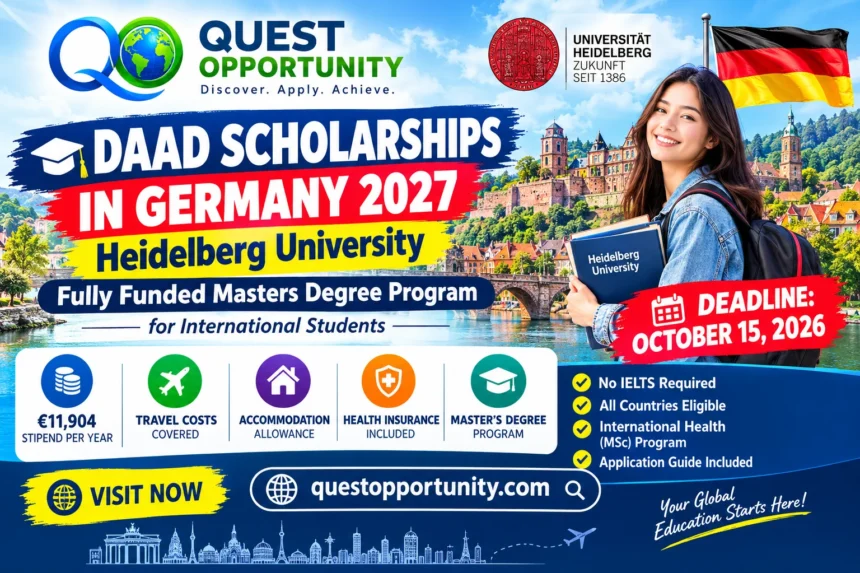
DAAD Scholarships in Germany 2027 offer international students an opportunity to pursue a master’s degree in Germany with financial support through the DAAD EPOS scholarship programme. The MSc in International Health at Heidelberg University is one of the programs listed in the EPOS listings for 2027/28. For international applicants, this guide explains the eligibility requirements, scholarship benefits, application procedure, required documents, and important deadlines.
The Master of Science in International Health (MScIH) at Heidelberg University is an opportunity to understand if you are looking for a Master’s degree in Germany that focuses on global health, public health, health systems, and health challenges in low- and middle-income countries.
The Heidelberg Institute of Global Health offers the program, which is taught in English. It focuses particularly on poverty-related health problems in low- and middle-income countries and combines academic study with research, health policy, management, and international health perspectives.
For international applicants interested in financial support, the DAAD Development-Related Postgraduate Courses (EPOS) scholarship is a separate funding route associated with the programme. Applicants should differentiate between applying for external scholarship funding and admission to the Master’s program, as the university states that it does not provide scholarships or financial assistance for the MScIH.
The program, eligibility requirements, support for scholarships, the application process, required documents, English-language requirements, important dates, and what prospective international students should know prior to applying are all covered in this guide.
Heidelberg University MSc International Health at a Glance
| Information | Details |
| University | Heidelberg University |
| Institute | Heidelberg Institute of Global Health |
| Programme | Master of Science in International Health |
| Degree | MSc |
| Study Level | Master’s |
| Country | Germany |
| Location | Heidelberg, Germany |
| Language | English |
| Full-Time Duration | 1 year |
| Part-Time Option | Up to 5 years |
| Study Start | Winter semester |
| Focus | International & Global Health |
| Scholarship Route | DAAD EPOS |
| DAAD Support | €992 monthly for graduates, plus applicable allowances |
| DAAD Scholarship Deadline | Check the current DAAD/course announcement |
| Programme Application | Online |
The official Heidelberg programme page currently describes the MScIH as a two-semester, English-language Master’s programme with a full-time option.
What Is the Heidelberg University MSc in International Health?
A postgraduate program focused on international and global health issues is the Master of Science in International Health.
The programme focuses particularly on health problems affecting low- and middle-income countries. Research methods, health policy, management, and other aspects of international health are among the topics that students study.
Professionals who want to learn more about public health, international health programs, health systems, research, policy, and health management will find this program particularly useful.
International students can complete the program without having to learn German as the primary language of instruction because the degree is taught in English. The program’s ability to be completed entirely in English is confirmed by Heidelberg University.
Is the Heidelberg MSc International Health Fully Funded?
The MScIH program itself is not supported by the university. Heidelberg University currently states that it does not provide scholarships or financial assistance for the MScIH and encourages prospective students to seek external funding.
However, applicants who meet the requirements can apply for funding through external organizations like DAAD. The DAAD EPOS programme provides scholarships for selected development-related postgraduate courses in Germany, including the Heidelberg MSc in International Health.
Therefore, it is more accurate to describe this as:
Heidelberg University MSc International Health + DAAD EPOS scholarship opportunity
rather than saying that Heidelberg University itself provides a fully funded scholarship to every admitted student.
This distinction is important when publishing scholarship information because admission and scholarship selection are separate processes.
What Does the DAAD EPOS Scholarship Provide?
According to the most recent information provided by the DAAD EPOS, Master’s-level graduates receiving scholarship support will receive a monthly payment of €992. A travel allowance and payments toward health, accident, and personal liability insurance are also provided by the DAAD, unless other sources cover travel expenses. Additional assistance, such as a monthly rent subsidy or family allowance, may be available in certain circumstances.
The main benefits can therefore include:
- €992 monthly scholarship payment
- Health, accident and personal liability insurance contributions
- Travel allowance, subject to the applicable conditions
- Possible monthly rent subsidy
- Possible family allowance under certain conditions
- Support during the funded study period
€992 per month corresponds to €11,904 over 12 months if paid for the full 12-month period.
However, applicants should not assume that every scholarship recipient automatically receives every additional allowance. Some benefits are said to be conditional by the DAAD, so applicants should check the current terms of the scholarship.
What Does the MSc International Health Programme Cover?
There are several major components to the MScIH curriculum.
Twenty ECTS are awarded for the Core Course, which serves as the program’s foundation. It covers areas including international health problems, determinants of health, research methods, and health policy and management.
The Advanced Modules that students complete allow them to acquire more specialized knowledge.
The final major component is the Master’s thesis and oral examination. Under academic supervision, students use qualitative and/or quantitative information from a primary study or literature review to work on a significant health issue.
Core Course
The six units of the Core Course provide students with a theoretical and methodological foundation in International Health.
According to Heidelberg University, the Core Course runs for approximately 14 weeks from September to December and accounts for 20 ECTS.
Advanced Modules
Students can delve deeper into specific international health topics through Advanced Modules.
Students can learn about topics that are relevant to their academic and professional interests thanks to this structure.
Master’s Thesis and Oral Examination
A Master’s thesis under the direction of an academic advisor is the final step.
The thesis can focus on an important health issue and may use qualitative or quantitative information from literature or primary research. A final oral examination on the program’s content and thesis is also completed by students.
Who Can Apply for the Heidelberg MSc International Health?
There are particular professional and academic requirements for the program.
The official Heidelberg application information states that successful applicants should have a four-year Bachelor’s degree or equivalent qualification of at least 240 ECTS in a discipline relevant to Public Health. Medical degrees and other relevant academic backgrounds may qualify.
Additionally, applicants are expected to have relevant work experience.
The requirement for professional experience is especially important for students applying through DAAD EPOS. According to information from the most recent DAAD EPOS, applicants typically need to have at least two years of professional experience in addition to a Bachelor’s degree in a relevant field.
Applicants should therefore carefully distinguish the standard university admission requirements from the additional conditions attached to the DAAD EPOS scholarship.
DAAD Scholarships Germany 2027 Eligibility Requirements
A relevant first degree is an important academic requirement.
The official Heidelberg information identifies a four-year Bachelor’s degree, or equivalent qualification of at least 240 ECTS, in a Public Health-relevant discipline. Degrees in medicine and other relevant academic backgrounds in the health field are examples.
Relevant backgrounds may therefore include areas connected with:
- Medicine
- Public Health
- Health Sciences
- Life Sciences
- Social Sciences
- Other relevant health-related disciplines
It is not enough for applicants to rely solely on the name of their degree. They should examine the programme’s admission regulations and determine whether their specific academic background meets the current requirements.
Work Experience Requirement
This opportunity relies heavily on prior work experience.
For the MScIH admission route, Heidelberg’s information describes relevant work experience as an expectation. For DAAD EPOS applicants, DAAD states that candidates generally need at least two years of professional experience relevant to the programme.
This means applicants should prepare clear evidence of their professional experience.
Useful evidence can include:
- Employment certificates
- Employer letters
- Official work contracts
- Professional references
- Documents showing employment dates
- Evidence describing relevant responsibilities
The connection between prior professional experience and future development-related work is especially crucial for scholarship applicants.
English Language Requirements
The MScIH is taught in English.
Heidelberg University requires applicants to demonstrate adequate English proficiency. The programme information indicates a minimum B2 level according to the Common European Framework of Reference for Languages (CEFR).
Depending on the current program rules, applicants may be able to demonstrate English proficiency through a recognized language test or English-speaking prior education.
IELTS isn’t always necessary, and students shouldn’t automatically assume that. Instead, they should determine whether they are eligible for an exemption based on their prior education and gather the required official documentation.
Is IELTS Required for Heidelberg University MScIH?
The response is contingent on the evidence accepted by the program and the individual educational background of the applicant.
According to the current program information, applicants must demonstrate proficiency in English. By providing official confirmation that English was the sole or principal language of instruction and appropriate academic transcripts, applicants who have previously completed tertiary education in English may be able to meet the requirement.
Therefore, it is safer to say:
IELTS may not be required in every case, but applicants must still satisfy Heidelberg’s English-language requirement.
Before submitting their application, applicants should verify their circumstances.
Required Documents for the Application
Applicants should prepare their documents well before the deadline.
The application materials can include:
- Bachelor’s degree certificate
- Official academic transcripts
- Curriculum vitae
- Proof of English proficiency
- Motivation letter
- Recommendation letter
- Employment certificates
- Passport copy
- DAAD application documents, when applying for EPOS
Scholarship applications may have additional documentation requirements, so DAAD EPOS applicants should carefully adhere to the current program-specific checklist. According to DAAD, applicants must fulfill the program’s academic, professional, language, and development-related requirements.
How to Apply for the Heidelberg MSc International Health
The application procedure ought to be approached in two steps that are connected but distinct.
Step 1: Check Your Eligibility
First, review the academic and professional requirements.
Check your degree, ECTS equivalence, professional experience, English proficiency, and other requirements before preparing the final application.
Step 2: Prepare Your Documents
Collect your academic records, CV, motivation letter, proof of professional experience, English-language evidence, passport, and recommendation documents.
Make sure names and dates are consistent across all documents.
Step 3: Apply for the MScIH
According to Heidelberg, online applications are accepted for the MScIH. Paper applications are not taken into consideration.
Applicants should use the official programme application system and follow the instructions provided for their admission cycle.
Step 4: Apply for DAAD EPOS Separately
The application procedure for scholarships is the one that must be followed by applicants for DAAD EPOS funding.
The DAAD scholarship is not simply granted automatically because a student has been admitted to the Master’s programme.
Therefore, applicants should adhere to the applicable deadlines when preparing both the DAAD scholarship application and university admissions application.
Step 5: Monitor Your Application
Check your email and the appropriate application system frequently following submission for messages from the scholarship or program organization.
Keep copies of everything submitted for your records.
Heidelberg MScIH Application Deadline
The DAAD EPOS scholarship deadline should be distinguished from the university admission deadline.
The DAAD EPOS deadline for the relevant 2027/28 cycle is listed separately from the standard university application route. The Heidelberg MSc in International Health is listed as an EPOS program on the most recent DAAD course deadline list for the 2027/28 intake.
According to third-party listings, the DAAD EPOS deadline for the 2027 intake is currently October 15, 2026. Heidelberg’s program information should be checked directly for the current application window.
Students who want DAAD funding should not wait until the regular university deadline because scholarship deadlines are earlier than the standard program application deadline.
Important Difference Between Admission and Scholarship Deadlines
For applicants, this is one of the most crucial points.
The general MScIH application deadline for a student may be later than the DAAD EPOS scholarship application deadline.
As a result, a person who waits until the regular program deadline may miss the chance to apply for DAAD funding.
Applicants should create two separate deadline reminders:
University admission deadline
and
DAAD EPOS scholarship deadline
The exact dates should be checked on the current official programme and DAAD pages before submission.
DAAD EPOS Eligibility
The DAAD EPOS is designed for postgraduate studies related to development.
According to the most recent information regarding the DAAD scholarship, applicants typically require a relevant Bachelor’s degree, at least two years of professional experience, strong academic performance, language skills, and a distinct motivation that is related to development.
Applicants should understand that satisfying the basic conditions does not guarantee a scholarship.
Candidates for DAAD EPOS scholarships are evaluated in accordance with the applicable program and scholarship criteria.
What Does DAAD Mean by Development-Related Study?
The EPOS programme is designed around postgraduate education that contributes to development-related professional work.
Therefore, the motivation for an International Health applicant should connect previous experience, the health issue the applicant wishes to address, the Master’s degree-required skills, and how those skills can be used professionally.
A strong application should be specific rather than simply stating that Germany is a desirable study destination.
Who Is the MSc International Health Designed For?
People who are interested in global health issues and international issues in general will find this program particularly relevant.
Potential applicants can include professionals working in:
- Public health
- Healthcare
- Medicine
- Health programme management
- Health research
- Development organisations
- Health policy
- Community health
- International health programmes
The exact suitability depends on the applicant’s academic background and professional experience.
Why Study International Health in Germany?
Germany is home to numerous international students and boasts a significant higher education sector.
For this particular programme, however, applicants should focus less on Germany in general and more on the specific academic value of the MScIH.
The Heidelberg programme provides structured education in international health, research methods, health policy, health systems, and related subjects.
Because of this, applicants who wish to acquire specialized knowledge in international and global health will find the program useful.
What Is the Duration of the Programme?
The MScIH program can be completed full-time in one year, which is the equivalent of two semesters.
Heidelberg also provides a route that can last up to five years and is part-time. Although they both lead to the same Master’s degree, their flexibility is different.
Students should carefully consider which study format fits their circumstances.
What Are the Tuition Fees?
The current Heidelberg University programme page lists €7,050 per semester for the MScIH.
The programme’s FAQ currently lists the one-year full-time tuition fee as €14,100, covering the Core Course, Advanced Modules, and thesis.
These figures are important for self-funded applicants.
To determine which expenses are covered by their scholarship, DAAD scholarship applicants should review the current scholarship and program arrangements.
Does Heidelberg University Provide Its Own Scholarship?
The MScIH program does not currently receive any financial support from Heidelberg University, as stated on the official Heidelberg scholarship page. The university encourages applicants to look for funding from outside sources.
For this reason, eligible applicants seeking external financial support should take the DAAD EPOS route.
It’s possible that additional external funding organizations will have their own deadlines and requirements.
Career Areas After an MSc in International Health
The degree may provide knowledge applicable to a number of careers in international health.
Graduates may use the knowledge gained in areas such as:
- Public health programmes
- Health policy
- Health programme management
- Research
- Health systems
- International development
- Monitoring and evaluation
- Health services
- Non-governmental organisations
- Government health programmes
- Further academic research
The Master’s degree, on the other hand, does not guarantee a particular job, salary, visa outcome, or permanent residence.
The outcomes of a person’s career are influenced by their qualifications, experience, location, language proficiency, and the employment market.
Application Checklist for International Students
Before submitting your application, use this checklist:
Academic Documents
- Bachelor’s degree.
- Official academic transcript.
- Evidence of 240 ECTS or equivalent where applicable.
- Certified documents where required.
Professional Documents
- Updated CV
- Employment certificates
- Evidence of relevant professional experience
- Employer recommendation
Language Documents
- English proficiency certificate if required
- Official evidence of English-medium education if using an exemption
Scholarship Documents
- DAAD application form
- DAAD checklist
- Motivation letter
- Recommendation letter
- Employment evidence
- Academic documents
- Passport copy
Common Mistakes to Avoid
Applicants ought to avoid preparing documents prior to the deadline.
The second error involves conflating selection for the DAAD EPOS scholarship with admission to Heidelberg University. These are processes that are related but distinct.
The assumption that “No IELTS Required” indicates that no English-language evidence is required is another error. In the current program, applicants must demonstrate proficiency in English, though in some cases, English-medium education may satisfy this requirement.
Applicants should also avoid using outdated scholarship information. Between academic years, funding amounts, application procedures, deadlines, and eligibility rules can change.
Final Thoughts
An English-taught Master’s program in international and global health is offered through the MSc in International Health at Heidelberg University. The programme combines core international-health concepts, research methods, advanced modules, and a Master’s thesis within a one-year full-time structure.
The DAAD EPOS scholarship is a separate funding opportunity that can provide international applicants seeking financial assistance with a monthly scholarship payment and additional benefits, subject to DAAD’s conditions.
The most crucial step is to carefully distinguish the requirements for DAAD scholarships from those for university admission. Before submitting an application, applicants should also check the most recent deadline and documentation requirements directly through the official Heidelberg and DAAD sources.
DAAD Scholarships in Germany 2027 – Heidelberg University MSc in International Health
What is the DAAD Scholarship in Germany 2027 for Heidelberg University?
The DAAD Scholarship in Germany 2027 for Heidelberg University is offered through the DAAD Development-Related Postgraduate Courses (EPOS) programme. It supports international applicants who want to study the MSc in International Health (MScIH) at Heidelberg University. The scholarship provides monthly funding and other benefits, but it is a separate application route from university admission.
Is the Heidelberg MSc in International Health fully funded by Heidelberg University?
No. Heidelberg University states that it does not provide scholarships or financial assistance for the MScIH. The programme is not fully funded by the university. However, eligible applicants can apply separately for the DAAD EPOS scholarship to receive financial support.
How much does the DAAD Scholarship in Germany 2027 pay?
According to the most recent DAAD EPOS information, Master’s-level graduates receive:
€992 monthly scholarship payment
Health, accident and personal liability insurance contributions
Travel allowance, subject to conditions
Possible monthly rent subsidy
Possible family allowance under certain conditions
At €992 per month, this equals €11,904 over 12 months if paid for the full period.
What does the DAAD EPOS scholarship cover for Heidelberg MScIH?
The DAAD EPOS scholarship can cover:
Monthly scholarship payment of €992
Insurance contributions
Travel allowance
Possible rent subsidy
Possible family allowance
Support during the funded study period
Applicants should check the current DAAD terms because some benefits are conditional.
Who can apply for the DAAD Scholarship in Germany 2027 at Heidelberg?
Applicants generally need:
A four-year Bachelor’s degree or equivalent of at least 240 ECTS in a Public Health-relevant discipline
At least two years of professional experience for DAAD EPOS
Strong academic performance
English language proficiency
A development-related motivation
Medical degrees and other relevant health-related backgrounds may qualify.
Is IELTS required for the DAAD Scholarship in Germany 2027 at Heidelberg?
Not always. IELTS may not be required if applicants can provide official evidence that English was the sole or principal language of instruction during previous tertiary education. However, applicants must still meet Heidelberg’s English-language requirement. It is safer to verify your individual situation before applying.
What is the DAAD Scholarship in Germany 2027 deadline for Heidelberg MScIH?
The DAAD EPOS scholarship deadline is separate from the university admission deadline. According to third-party listings, the DAAD EPOS deadline for the 2027 intake is currently October 15, 2026. However, applicants should check the current official DAAD and Heidelberg pages because deadlines can change.
What is the difference between the DAAD scholarship deadline and the university admission deadline?
The DAAD EPOS scholarship deadline is usually earlier than the general university admission deadline. If you wait until the regular MScIH application deadline, you may miss the DAAD funding opportunity. Applicants should set two separate reminders:
University admission deadline
DAAD EPOS scholarship deadline